Apartment-friendly does not just mean small. A tiny dog that barks at every footstep in the hallway is a far worse apartment companion than a large, calm one that sleeps most of the day. The traits that actually decide whether a dog thrives in a flat are energy level, how much it barks, how well it tolerates being alone, and how adaptable it is to a confined space, not the number on the scale. This guide ranks what really matters, lists breeds that genuinely suit apartment life, and explains why some popular “small” picks are a poor fit.
The honest principle is to match the dog to your space, schedule, and tolerance for noise, rather than choosing on looks or size alone. Get that right and almost any well-matched dog can be happy indoors; get it wrong and even the smallest breed becomes a daily strain.
The traits that actually matter
Before any breed list, judge a dog against the four things that decide apartment success. A dog that scores well here will adapt; one that does not will struggle whatever its size.
- Energy level: a dog that needs hours of hard exercise will be frustrated indoors unless you commit to meeting that need.
- Bark frequency: shared walls make a vocal dog a problem for you and your neighbours.
- Tolerance for alone time: a dog that panics when left risks distress and noise complaints.
- Adaptability: some dogs settle anywhere, while others need routine and space to feel secure.
Breeds that genuinely suit apartments
Calm small and medium breeds
Many smaller breeds do well precisely because they are content with moderate exercise and indoor play, provided their minds are kept busy. Think companion breeds that bond closely and settle quickly once their needs are met.
Surprising larger picks
Some larger dogs are excellent apartment dwellers because they are low-energy and quiet, sleeping much of the day and needing only steady walks. A calm large dog can be a better fit than a high-strung small one, which is why size alone is a poor filter.
Adaptable companions
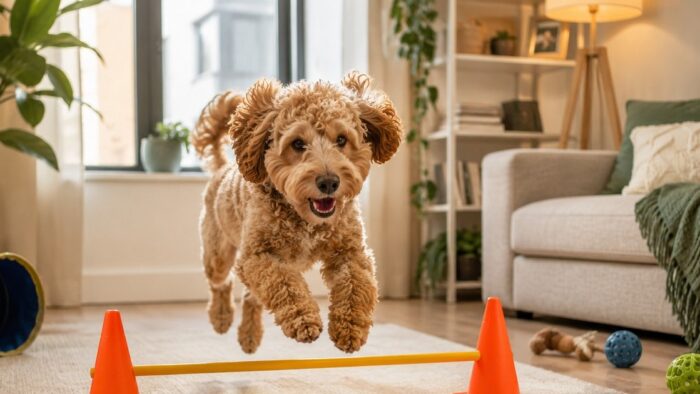
Breeds bred mainly for companionship tend to adapt best, since they want to be near you rather than working or running. They thrive on closeness, short walks, and indoor enrichment, the kind described in our guide to indoor activities for energetic dogs.
Breeds to think twice about
- High-energy working and sporting breeds that need a job and serious daily exercise to stay sane indoors.
- Notably vocal breeds whose barking carries through shared walls.
- Dogs prone to separation distress if your schedule means long hours alone.
- Breeds needing intense mental and physical stimulation that a flat cannot easily provide.
None of these is impossible in an apartment, but each demands far more from you in exercise, training, and enrichment, so go in with eyes open rather than charmed by a photo.
Making any apartment dog succeed
Breed is a starting point, not a guarantee. The environment and routine you provide matter just as much, and a well-set-up home turns a borderline match into a happy one.
- Meet the exercise need every day, with walks plus indoor play, so energy does not turn into destruction or barking.
- Build a calm, predictable routine, which dogs find deeply reassuring in a small space.
- Set up the home thoughtfully, as in our guide to creating a pet-friendly apartment, with a settled spot of the dog’s own.
- Address barking early with training rather than letting it become a habit; our guide to stopping apartment barking covers how.
Common mistakes
- Choosing by size alone and ending up with a small but hyperactive, vocal dog.
- Picking a high-energy breed for its looks, then failing to meet its exercise needs.
- Ignoring how much a dog barks until the neighbours complain.
- Underestimating alone-time needs for a dog left for long workdays.
- Assuming a flat alone is enough, without daily exercise and enrichment.
Editor’s note
The best apartment dog is the one whose energy and temperament match your real life, not the cutest face in the shelter or the smallest breed on a list. Be brutally honest about your schedule and your tolerance for noise before you choose. A calm, adaptable dog whose needs you can genuinely meet will be a joy in a flat, while a mismatched dog will be unhappy and so will you. Choose for fit, set the home up well, and meet the exercise and enrichment needs daily, and apartment life suits dogs far better than people assume.
Frequently asked questions
Are small dogs always better for apartments?
No. Size matters less than energy, barking, and temperament. A calm large dog can suit a flat better than a hyperactive, vocal small one. Judge a breed by how much exercise and stimulation it needs and how quietly it settles, not by its weight.
Can high-energy dogs live in apartments?
Yes, but only if you commit to meeting their exercise and enrichment needs every day through walks, play, and mental challenges. Without that outlet, a high-energy dog becomes frustrated, destructive, and noisy indoors, so be realistic about the time it demands.
How much exercise does an apartment dog need?
It depends on the breed, but every dog needs daily walks plus indoor play and mental stimulation. Lower-energy breeds may be content with a couple of short walks, while active ones need substantially more. Meeting the need consistently is what keeps any dog calm indoors.
What if my dog barks at every noise in the hallway?
Hallway barking is common in apartments and very manageable with training. Reward calm behaviour, avoid reinforcing the barking with attention, and gradually desensitise the dog to common sounds. Keeping the dog well exercised and mentally tired also reduces reactive barking, and consistent early training prevents it from becoming an ingrained habit that troubles neighbours.
Do apartment dogs need a yard to be happy?
No. A yard is convenient but not essential; what dogs need is daily walks, exercise, and mental stimulation, all of which an apartment owner can provide. Many dogs in yards are under-exercised because owners assume the yard does the work, while attentive apartment owners often keep their dogs fitter and better stimulated through deliberate daily activity.
How do I choose between two suitable breeds?
Look past appearance to the practical fit with your life: your activity level, working hours, tolerance for noise and shedding, and experience with dogs. A breed that matches your real routine will settle far better than one you find prettier. Where possible, meet adult dogs of each breed, since individual temperament varies, and an adult shows you what a puppy will become.