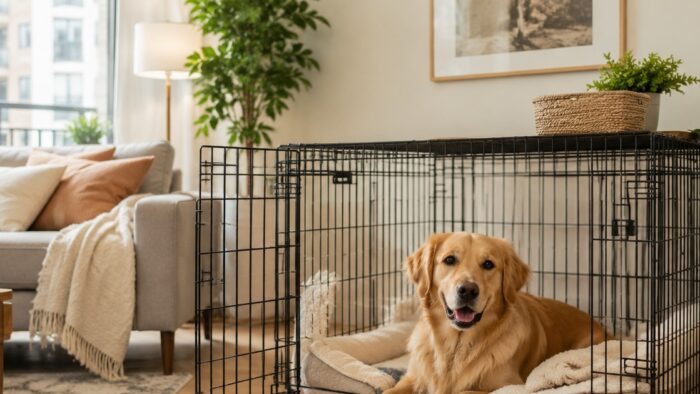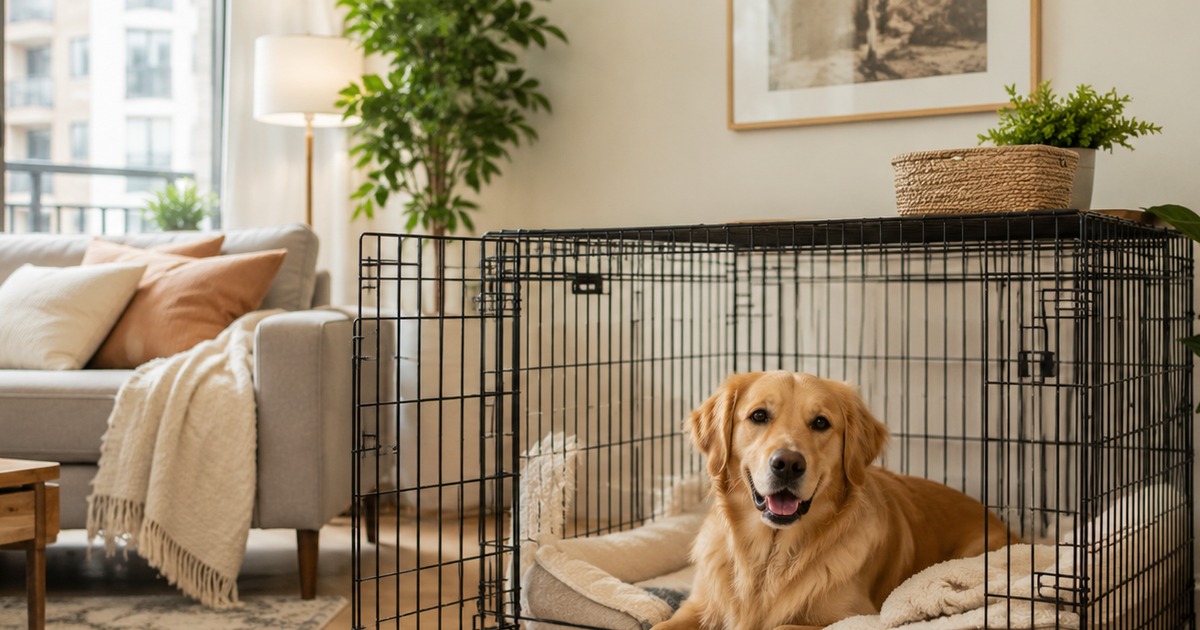
A dog crate has an image problem. To many people it looks like a cage, but used correctly it is the opposite, a den, a safe and private space the dog chooses for itself, and one of the most useful tools for apartment living. The key word is correctly: a crate that is the wrong size, or used as punishment or confinement for long hours, becomes exactly the prison its critics imagine. This guide covers how to choose the right crate for a flat, the sizing rule that actually matters, the types available, and how to use it so the dog loves it rather than fears it.
The honest principle is that a crate works because dogs are den animals that seek a secure, enclosed space, but only when the crate is sized right and associated with good things. Get the size and the introduction right and the crate becomes the dog’s favourite spot rather than a place it dreads.
The sizing rule that matters
Size is the single most important choice, and the one people get wrong most often. The crate should let the dog stand up fully, turn around, and lie down stretched out, and no bigger than that for a puppy in training.
- Too small is cruel; the dog cannot stand or turn comfortably.
- Too big undermines house training, since the dog can soil one end and sleep in the other.
- For a growing puppy, buy for the adult size and use a divider to shrink the usable space as it grows.
- Measure your dog standing and lying, and choose to those dimensions rather than guessing.
Correct sizing is also what makes a crate so effective for the house training covered in our realistic puppy house-training guide.
Types of crate
Wire crates
The most versatile and popular for home use: well-ventilated, foldable, easy to clean, and usually supplied with a divider. The open sides suit dogs that like to see out, and a cover can be added for a more den-like feel. The default choice for most flats.
Plastic crates
More enclosed and den-like, which suits dogs that prefer to burrow away, and useful for travel. They offer less ventilation and visibility, so they suit some temperaments better than others.
Soft and fabric crates
Light and portable, good for calm, already crate-trained dogs and for travel, but no match for a chewer or an anxious dog that will claw or bite its way out. Not a training crate.
Furniture-style crates
Designed to double as a side table or be less obtrusive in a small flat. Handy for looks and space, but check the size is still correct for the dog and not compromised for the sake of appearance.
Making the crate a happy place
A crate only works if the dog likes it, which depends entirely on how you introduce it. Never use it for punishment, and build positive associations from the start, the same calm, reward-based approach behind good anxiety prevention.
- Introduce it gradually, feeding meals and offering treats inside so the dog enters willingly.
- Make it comfortable with soft bedding and a familiar item, and place it in a quiet corner.
- Never use the crate as a punishment, or the dog will come to fear it.
- Keep crate time reasonable; a crate is a den and a tool, not a place to store a dog all day.
How a crate helps apartment life
In a small flat, a crate earns its place beyond training: it gives the dog a defined territory of its own, helps an anxious dog feel secure, and protects the home while you settle the dog in, all part of a well-set-up pet-friendly apartment. It also gives a dog a safe retreat when the home is busy, which many dogs use voluntarily once they have learned to love it.
Common mistakes
- Choosing the wrong size, too small to be humane or too big for house training.
- Using the crate as punishment, so the dog fears rather than enjoys it.
- Leaving a dog crated for far too long, which is confinement, not denning.
- Buying a soft crate for a chewer or escape artist that will destroy it.
- Rushing the introduction instead of building positive associations gradually.
Editor’s note
The crate debate usually comes down to a misunderstanding: a crate used as a long-stay cage is indeed unkind, while a correctly sized crate introduced with patience becomes a dog’s favourite den, a place it retreats to by choice. In an apartment that distinction is gold, giving the dog security and you a house-training aid and a protected home. Buy for the adult size with a divider, introduce it slowly with food and comfort, never use it as punishment, and keep the hours reasonable. Do that and the crate stops looking like a cage and starts working like a bedroom. Buy for the adult size, pick the type that suits your dog, introduce it with patience, and keep the hours sensible, and you will wonder how you managed a flat without one.
Choosing the crate is only half the job; teaching the dog to love it is covered in our guide to crate training a dog the right way.
Frequently asked questions
What size crate does my dog need?
Large enough to stand up fully, turn around, and lie down stretched out, and no larger for a puppy in training. For a growing dog, buy the adult size and use a divider to limit the space as it grows, since too much room lets a puppy soil one end and sleep in the other, undermining house training.
Is it cruel to crate a dog?
Not when done correctly. A properly sized crate introduced positively becomes a safe den the dog chooses to use. It becomes cruel only when it is the wrong size, used as punishment, or used to confine a dog for excessively long periods. The crate itself is a tool; how it is used determines whether it is kind or not.
How long can a dog stay in a crate?
Crate time should be limited and reasonable, not a way to store a dog all day. Puppies can hold it only for short periods related to their age, and adult dogs should not be crated for very long daily stretches. A crate is for rest, training, and security, with plenty of time outside it for exercise, company, and toileting.
How do I get my dog to like its crate?
Build positive associations slowly. Feed meals and offer treats inside, make it comfortable with bedding, leave the door open at first so the dog explores freely, and never use it as punishment. Praise the dog for going in, and lengthen the time gradually. Most dogs come to treat a well-introduced crate as their own safe retreat within a couple of weeks.