Clicker training is one of the most effective and humane ways to teach an animal, and one of the most misunderstood. People imagine it is complicated, or only for dogs, when in fact it is beautifully simple and works on cats, rabbits, and other pets just as well. At its heart, the clicker solves one problem that bedevils all training: timing. It lets you tell the animal, with perfect precision, exactly which action earned the reward. This guide explains how clicker training works, why it is so effective, and how to start with a dog or cat, step by step.
The honest principle is that animals learn fastest when the reward is precisely linked to the right action, and the click is simply a clear, consistent marker that says “yes, that, now a reward is coming”. Get that link right and training becomes faster, kinder, and genuinely enjoyable for both of you.
How clicker training works
The method rests on a simple idea: a distinct sound, the click, is paired with a reward until it means “well done, a treat is coming”. Once the animal makes that connection, the click can mark the exact instant of a correct action, far more precisely than a word or a delayed treat ever could.
- The click is a clear, consistent sound the animal does not hear elsewhere.
- It marks the precise moment of the right behaviour, removing the guesswork.
- It bridges the gap between the action and the reward that follows.
- It works across species, because the underlying learning is universal.
Getting started: charging the clicker
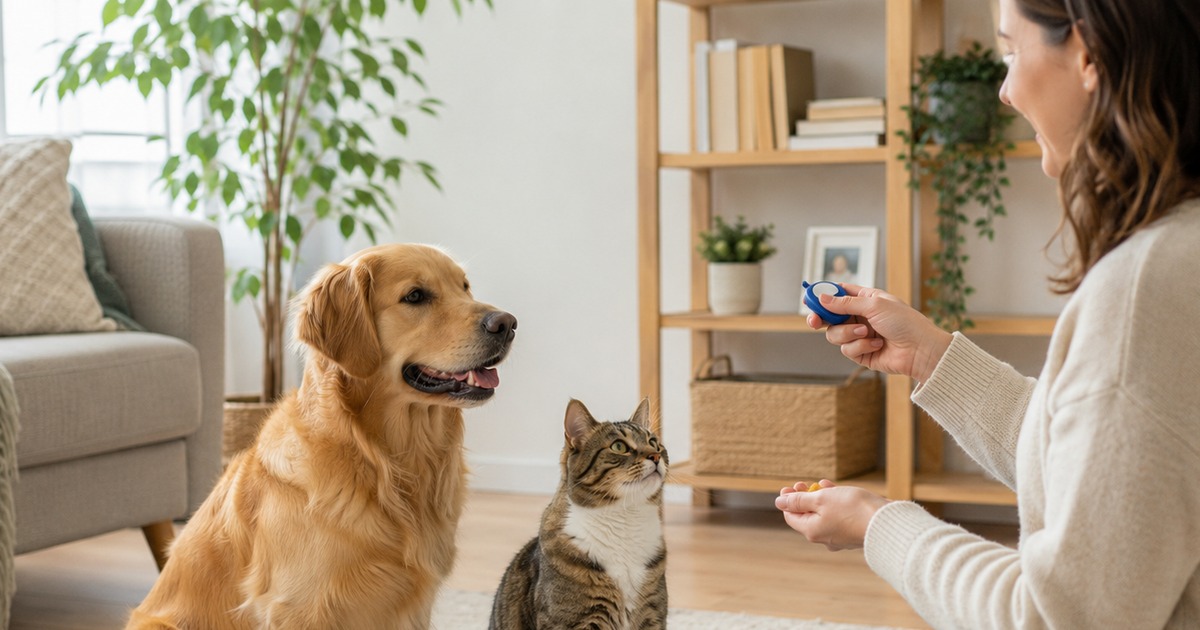
The first step is teaching the animal what the click means, sometimes called “charging” or “loading” the clicker. You simply click and immediately give a small treat, several times, until the animal’s ears prick at the sound in anticipation. No behaviour is being trained yet; you are just building the association that click equals reward, which everything else depends on.
Marking and rewarding behaviour
- Wait for or prompt the behaviour: let the animal offer a small action, like sitting or touching your hand.
- Click the instant it happens: mark the exact moment with a single click.
- Reward immediately: follow every click with a small treat, every time.
- Repeat and build: once reliable, add a cue word and gradually shape more complex behaviours.
Keep sessions short and upbeat, a few minutes at a time, since both dogs and cats learn best in brief, positive bursts rather than long drills.
Yes, it works on cats
Cats are often called untrainable, which is simply false; they are just less inclined to work to please you and more inclined to work for a clear, worthwhile reward, which is exactly what clicker training offers. It can teach a cat to come, sit, use a scratching post, or accept handling, and doubles as enrichment, since the mental work tires and satisfies a cat. It pairs perfectly with keeping an indoor cat happy and stimulated, turning training into play.
Using it for everyday training
Clicker training is not just for tricks; it makes everyday training clearer and faster. It is a natural fit for the reward-based approach behind our puppy house-training guide, and for teaching the calm behaviours that help with issues like apartment barking, where precisely marking and rewarding quiet is exactly what the clicker excels at. Once you have the basics, you can apply the same method to almost anything you want to teach.
Common mistakes
- Clicking too late, so the animal links the reward to the wrong action.
- Clicking without always following through with a reward, which weakens the signal.
- Running long, repetitive sessions that bore the animal.
- Using the click as attention-getting noise rather than a precise marker.
- Assuming cats cannot be trained and never trying.
Editor’s note
If you have struggled to train a pet, the problem was almost certainly timing, and the clicker fixes exactly that. The magic is not the gadget but the precision: being able to tell the animal, to the split second, “that is what earned the treat”. Charge the clicker first so the sound has meaning, then keep your sessions short, your clicks accurate, and your rewards immediate and consistent. Do that and you will be astonished how quickly a dog, or a supposedly aloof cat, starts offering behaviours to make that click happen. It is training as a game both of you enjoy.
Frequently asked questions
What is clicker training and how does it work?
It is a reward-based method where a distinct click sound marks the exact moment an animal does the right thing, immediately followed by a treat. After pairing the click with rewards, the animal learns that the click means “that was right”, giving you precise, clear communication that speeds up learning for almost any behaviour.
Can you really clicker train a cat?
Yes. Cats respond well to clear, rewarding training, and the clicker suits them perfectly. You can teach a cat to come, sit, use a scratching post, or tolerate handling, and the mental work doubles as enrichment. Cats are not untrainable; they simply work for a worthwhile reward rather than to please, which is what clicker training provides.
Do I have to use the clicker forever?
No. The clicker is a teaching tool, most useful while the animal is learning a new behaviour. Once a behaviour is well established, you can phase out the clicker for that behaviour and rely on a verbal marker and occasional rewards. Many people keep a clicker handy for teaching new things while using everyday cues for learned ones.
What treats work best for clicker training?
Small, soft, high-value treats the animal loves and can eat quickly work best, so training keeps moving and the reward feels worthwhile. Keep pieces tiny, since you will give many, and account for them in the daily food allowance to avoid overfeeding. For some pets, a favourite toy or play can serve as the reward instead of food.
How long should clicker training sessions be?
Short, just a few minutes at a time, several times a day if you like. Both dogs and cats learn best in brief, upbeat bursts and lose focus in long drills. Ending each session while the animal is still keen, rather than pushing until it is bored or frustrated, keeps it eager for the next one and makes training something it looks forward to. Several brief, happy sessions through the day beat one long one, and they fit easily around ordinary life, which is part of why clicker training is so sustainable for busy owners. Even a few minutes here and there add up, so it suits almost any schedule.