A bowl of food that appears twice a day is the easiest thing in the world for a pet, and that is exactly the problem. In the wild, animals spend much of their time working to find food, and a pet that gets its meals for free misses out on the mental stimulation that work would provide. Puzzle feeders fix this by making the pet think, nudge, or forage to release its food, turning a thirty-second meal into a satisfying mental workout. This guide explains why puzzle feeders are so effective for both dogs and cats, the benefits beyond entertainment, and how to introduce one without frustrating your pet.
The honest principle is that pets are built to work for food, and letting them do so engages their minds, slows fast eaters, and channels energy that would otherwise turn into boredom or mischief. A puzzle feeder is one of the highest-value, lowest-effort pieces of enrichment you can offer.
Why puzzle feeders work so well
- Mental stimulation: problem-solving engages the brain and tires a pet more than physical play alone.
- Slower eating: they stop a pet gulping food too fast, which aids comfort and digestion.
- Channelled energy: a foraging task absorbs energy that would otherwise feed boredom or barking.
- Instinct satisfied: working for food mimics natural foraging and hunting, which pets find deeply rewarding.
- Weight management help: slower, mindful eating supports the goals in our guide to healthy weight.
Types of puzzle feeder
Treat-dispensing balls and toys
The pet nudges or rolls the toy to release kibble through a hole. Simple, durable, and great for dogs especially, these also encourage movement as the pet chases the toy around.
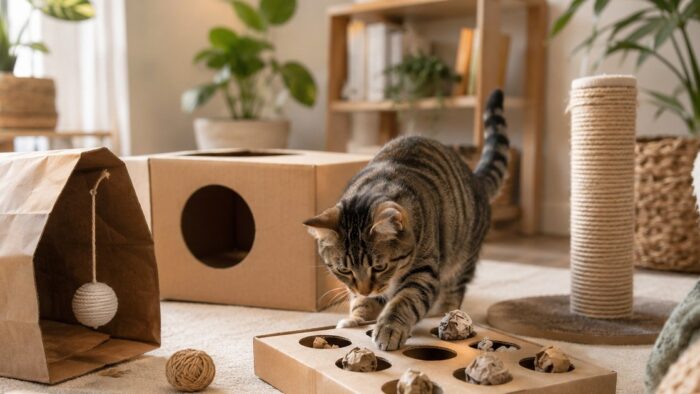
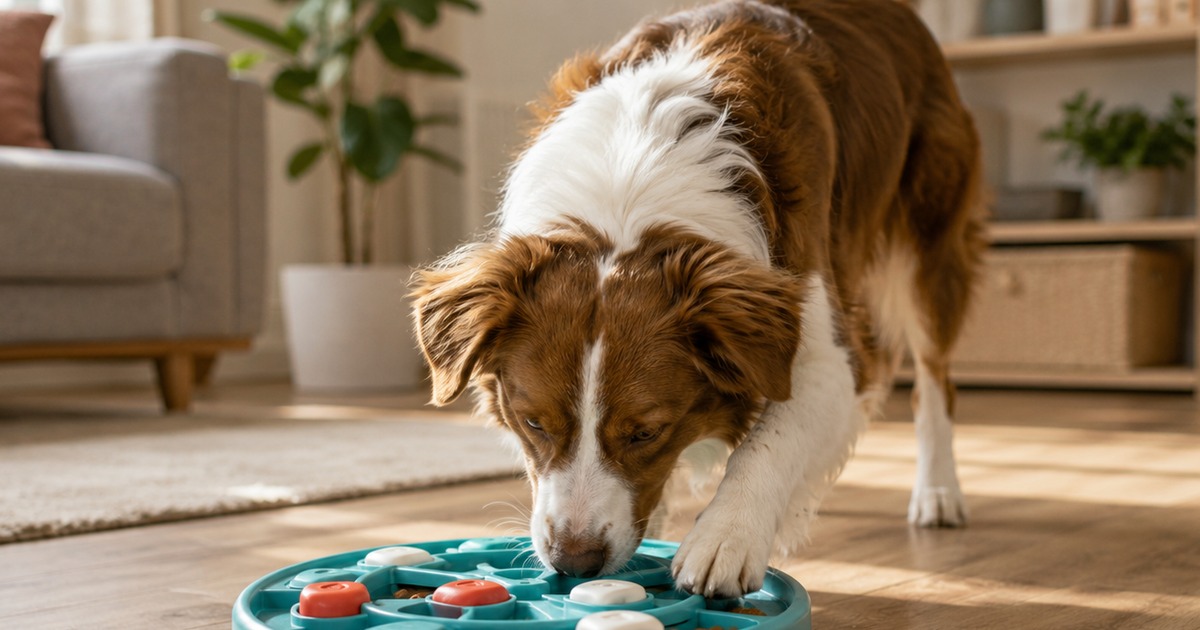
Puzzle boards and games
Boards with sliding, lifting, or flipping compartments the pet must manipulate to find food. These offer adjustable difficulty and are excellent for dogs and clever cats alike.
Slow-feeder bowls
Bowls with ridges and mazes that the pet must eat around, slowing fast eaters without much mental challenge. A good gentle introduction and ideal for gulpers.
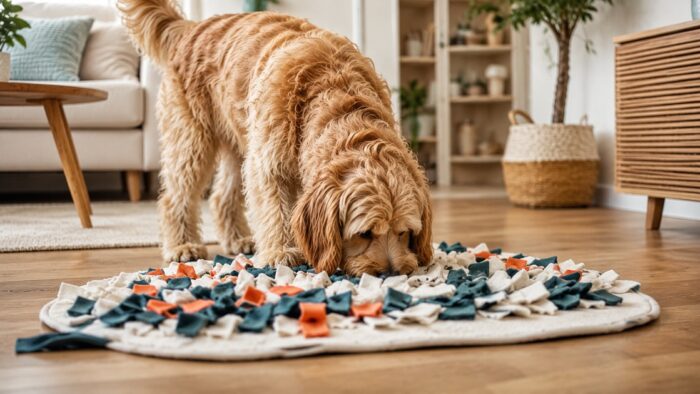
Snuffle mats and foraging toys
Fabric mats that hide food among folds for the pet to sniff and forage out, satisfying the nose and suiting dogs and cats that enjoy searching.
How to introduce one
- Start easy: begin with the simplest setting so the pet succeeds quickly and stays motivated.
- Use favourite food: high-value treats or the pet’s normal kibble give a strong incentive.
- Show how it works: demonstrate the first releases so the pet understands the game.
- Increase difficulty gradually: make it harder only once the pet has mastered the current level.
Patience at the start is everything; a puzzle that is too hard too soon frustrates a pet and puts it off, while early success builds enthusiasm.
Puzzle feeders for dogs and cats
For dogs, puzzle feeders are a cornerstone of indoor enrichment, doing as much to settle an energetic dog as exercise, which is why they feature throughout our guide to indoor activities for energetic dogs. For cats, turning a meal into a foraging hunt is excellent enrichment and pairs naturally with the homemade ideas in our guide to DIY cat enrichment. Both species benefit from the same simple shift: making food something to be earned rather than simply served.
Common mistakes
- Starting on too hard a setting, frustrating the pet into giving up.
- Never increasing the difficulty, so the puzzle becomes boring once mastered.
- Using a feeder too small or large for the pet, or not durable enough.
- Forgetting to count the food in the puzzle toward the daily ration.
- Leaving a chewable puzzle with a determined chewer unsupervised.
Editor’s note
If I could get every pet owner to make one small change, it would be to stop serving meals in a plain bowl and start making the pet work for at least some of its food. It costs almost nothing, takes seconds to set up, and transforms a dull, instant meal into the foraging task a dog or cat is built to enjoy. The mental workout tires a pet, slows a gulper, and soaks up the energy that otherwise becomes trouble. Start easy so your pet succeeds, ramp up the challenge over time, and you will wonder why you ever just tipped food into a bowl.
Frequently asked questions
What are the benefits of a puzzle feeder?
They provide mental stimulation, slow down fast eaters, channel energy that would otherwise cause boredom or mischief, and satisfy the natural urge to forage. For many pets this makes them calmer and more content, and the slower eating can aid digestion and support healthy weight management.
How do I get my pet to use a puzzle feeder?
Start on the easiest setting with food your pet loves, demonstrate the first few releases so it understands the game, and let it succeed quickly to build motivation. Increase the difficulty only once the current level is mastered. Patience early on is key, since a puzzle that is too hard at first can put a pet off entirely.
Are puzzle feeders good for cats too?
Yes. Cats are natural hunters and foragers, and a puzzle feeder turns a meal into a satisfying hunt, providing excellent enrichment and slowing fast eaters. Start with a simple design and easy difficulty, since cats can be quicker to give up than dogs if frustrated, and build from there as the cat gets the idea.
Can puzzle feeders help with weight control?
They can support it. Slower, more mindful eating helps a pet feel satisfied, and the mental and physical effort of foraging adds a little activity. They are not a substitute for correct portions and exercise, and the food in the puzzle should count toward the daily ration, but as part of a vet-guided plan they are a useful, low-effort aid to managing weight.
Can I make my own puzzle feeder at home?
Easily. A cardboard box or tube with holes, an egg carton with treats in the cups, a muffin tray, or food scattered for foraging all make effective homemade puzzle feeders for next to nothing. Start simple so your pet succeeds, supervise if it tends to chew and swallow cardboard, and you have enrichment as good as many shop-bought options.
Are puzzle feeders suitable for every pet?
Most dogs and cats benefit, but match the puzzle to the individual. Start easy for a pet new to them or one that frustrates quickly, choose sturdy designs for determined chewers and supervise accordingly, and pick an appropriate size. Pets with certain physical limitations may need gentler designs, so adapt to your pet rather than assuming one feeder suits all.