Indoor cats live longer and safer lives than outdoor ones, but they pay for it in boredom, and boredom is behind most of the behaviour problems owners complain about: scratching furniture, overgrooming, yowling, and aggression. A cat kept indoors needs you to recreate the hunting, climbing, and exploring it would do outside, or that energy turns inward and sour. The good news is that an enriched indoor life is easy to build once you understand what a cat actually needs. This guide covers exactly that, with practical, affordable ways to keep an indoor cat genuinely content.
The core idea is that cats are predators and need to express hunting behaviour, stalk, chase, pounce, capture, every day. Meet that instinct and most “behaviour problems” simply dissolve, because they were boredom and frustration all along.
Vertical space and territory
Cats live in three dimensions and feel safest when they can climb and survey their territory from above. A flat with no vertical options frustrates them, while one with height feels rich and secure.
- Provide climbing and perching options so the cat can get up high and look down on its world.
- Place a perch by a window for “cat TV”, the single best free entertainment there is.
- Give multiple resting spots at different heights so the cat can choose its mood.
- Invest in a good cat tree; our guide to the best cat trees for small spaces covers choosing one that fits a flat.
Play that satisfies the hunter
The most important daily ritual is interactive play that lets the cat complete the full hunting sequence. A wand toy moved like prey, ending in a “catch”, drains energy and satisfies instinct in a way a ball left on the floor never will. Two short sessions a day transform most indoor cats. Pair this with the kind of self-directed enrichment in our DIY cat enrichment ideas, and the cat has both partnered and solo outlets.
Feeding the mind, not just the bowl
A bowl of food appearing twice a day is the opposite of how a cat is built to eat. Making the cat work a little for food engages its mind and slows fast eaters. Puzzle feeders and scattered or hidden portions turn mealtime into the hunt it should be, which is one of the most effective and underused forms of enrichment.
Scratching: redirect, do not punish
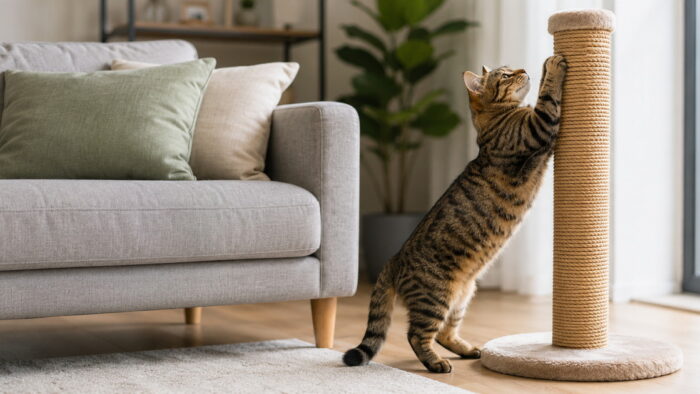
Scratching is not bad behaviour; it is essential for claw health, marking, and stretching. The goal is to give better targets than your sofa.
- Offer both vertical posts and horizontal scratchers, since cats have preferences.
- Place scratchers where the cat already wants to scratch, near sleeping spots and entrances.
- Choose sturdy, tall posts that do not wobble, which cats dislike.
- Never punish scratching; redirect to the right surface and reward use of it.
Routine, calm, and company
Cats are creatures of habit, and a predictable routine of play, feeding, and quiet reduces stress and the problems it causes. Sudden change, isolation, or a chaotic home can make a cat anxious, and a stressed cat is an unhappy one. If you see signs of ongoing anxiety, the approaches in our guide to reducing pet anxiety naturally can help, alongside keeping the daily rhythm steady.
Common mistakes
- Leaving toys on the floor and assuming the cat will entertain itself; cats need interactive play.
- Providing no vertical space, so the cat has nowhere to climb or survey.
- Free-feeding from a bowl and missing the enrichment that working for food provides.
- Punishing scratching instead of redirecting it to proper surfaces.
- Blaming the cat for “bad behaviour” that is really unaddressed boredom.
Editor’s note
Almost every indoor-cat problem owners describe to me, the shredded sofa, the 3 a.m. yowling, the overgrooming, traces back to a cat with nothing to hunt and nowhere to climb. The fix is rarely complicated: two short sessions of real interactive play a day, some vertical space, and food the cat has to work for. Do those three things consistently and a “difficult” cat usually becomes a contented one within weeks. An indoor cat can live a wonderful life, but only if you bring the outdoors in, in the form of things to stalk, climb, and conquer.
Two common follow-on questions for indoor cats are stopping furniture damage and adding a second cat, both covered in our guides to stopping a cat scratching the furniture and introducing a new cat.
Frequently asked questions
How much playtime does an indoor cat need?
Aim for at least two interactive sessions a day of around ten to fifteen minutes each, using a wand or similar toy that lets the cat chase and catch. Short, regular sessions that satisfy the full hunting sequence matter more than one long one.
Why does my indoor cat seem bored or destructive?
Almost always because its hunting, climbing, and exploring instincts are not being met. Scratching, yowling, and overgrooming are usually signs of boredom or stress, not defiance. Adding interactive play, vertical space, and food puzzles typically resolves them.
Do indoor cats need company when I am out?
They benefit from a stimulating environment more than constant company. Window perches, safe toys, and food puzzles keep a cat occupied while you are away. Some cats enjoy a compatible feline companion, but a well-enriched solo cat can be perfectly content.
Is it cruel to keep a cat entirely indoors?
Not at all, provided you meet its needs. Indoor cats avoid traffic, predators, and disease and tend to live longer, and a home rich in climbing, play, and mental challenge gives them a full life. The cruelty is not the indoors itself but leaving a cat in a bare, unstimulating space, which is exactly what good enrichment prevents.
Should I get a second cat for company?
Sometimes, but not always. A compatible second cat can provide companionship and play, especially for a social, under-stimulated cat, but a poorly matched pairing creates stress and territorial conflict. Many single cats are perfectly content when their environment is rich in play, climbing, and food puzzles, so enrich first and consider a companion only if the cat is clearly social and lonely.
How do I stop my cat scratching the furniture?
Give better alternatives rather than punishing the cat. Place sturdy scratching posts and horizontal scratchers where the cat already wants to scratch, near sleeping spots and doorways, and reward their use. Cats scratch to mark, stretch, and maintain their claws, so the aim is to redirect a natural need to acceptable surfaces, not to eliminate it.
What is the best free way to entertain an indoor cat?
A window perch with a view of birds, people, or traffic is the best free entertainment there is, often holding a cat’s attention for hours. Pair it with short daily sessions of interactive play using a simple wand or even a piece of string moved like prey, and rotate a few cheap toys so they feel novel. Stimulation matters far more than spending.