Keeping an indoor cat mentally and physically engaged does not require a cupboard full of expensive toys; some of the best enrichment costs almost nothing and uses things you already have. Cats are driven by powerful instincts to hunt, forage, climb, and explore, and DIY enrichment simply gives those instincts an outlet. A cardboard box can entertain a cat more than a pricey gadget, if you know how to use it. This guide offers simple, cheap, genuinely effective enrichment ideas you can make at home, all aimed at satisfying what a cat is actually built to do.
The honest principle is that enrichment works when it taps an instinct, not when it is clever or costly. A homemade foraging puzzle that makes a cat hunt for kibble beats an expensive electronic toy it ignores, because it speaks to what the cat genuinely wants to do.
Foraging and food puzzles
Making a cat work a little for food is one of the most powerful forms of enrichment, since it mimics hunting. You can make effective foragers from household items in minutes.
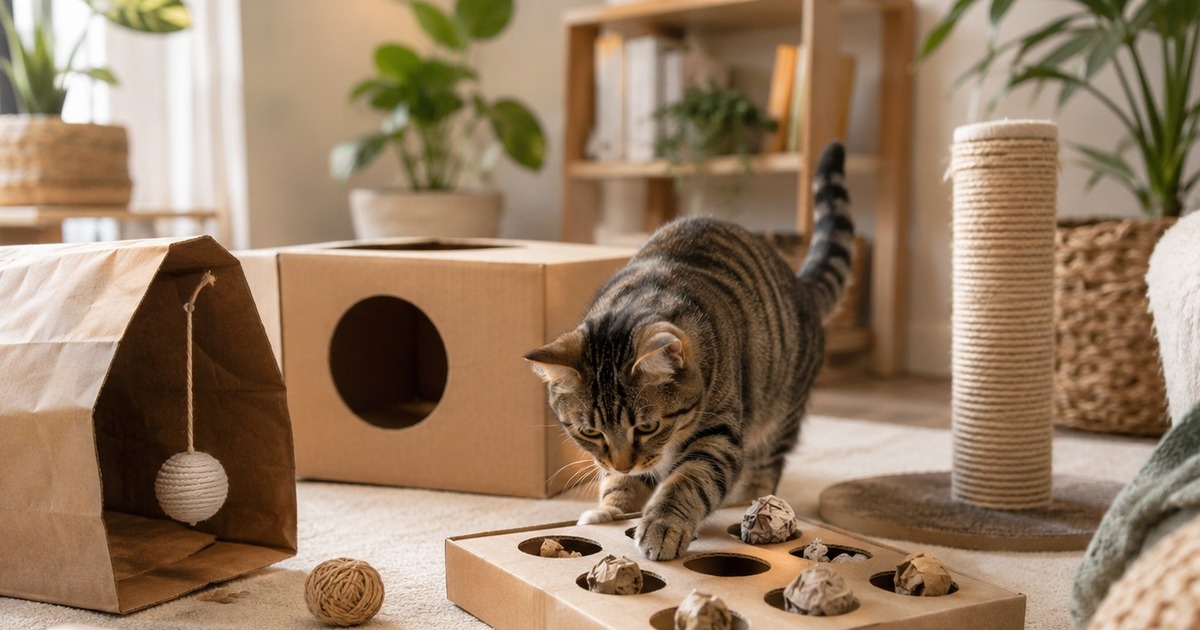
- Cut paw-sized holes in a cardboard box or tube and hide kibble inside for the cat to fish out.
- Scatter or hide small portions of food around a room so the cat hunts for its meal.
- Use an empty egg carton or a muffin tray with treats in the cups for a simple foraging puzzle.
- Pair these with the shop-bought options in our guide to puzzle feeders for variety.
Hunting and play
Cats need to stalk, chase, and pounce, and you can satisfy this cheaply. A length of string or a feather tied to a stick becomes a wand toy that lets you mimic prey, and crumpled paper balls or a cork make perfect things to bat and chase. The crucial detail is to let the cat “catch” the prey at the end, since an endless chase with no capture frustrates rather than satisfies. Short, daily interactive sessions like these are central to keeping an indoor cat happy.
Climbing, hiding, and exploring
- Cardboard boxes of different sizes, which cats adore for hiding, ambushing, and napping.
- A paper bag (handles removed) for a cheap, rustly hideout and pounce target.
- Rearranged furniture or a few sturdy shelves to create new climbing routes and vantage points.
- A simple window perch so the cat can watch the world, the best free entertainment there is.
For sturdier permanent climbing options, our guide to the best cat trees for small spaces covers what to buy, but homemade additions extend any setup cheaply.
Rotating to keep it novel
The secret that makes cheap enrichment work long-term is rotation. A cat with everything available at once loses interest; a cat given a few items that change every few days finds them perpetually new. Keep most homemade toys and boxes put away and bring out a fresh selection regularly, so the same cardboard box becomes exciting again after a week out of sight. Novelty, not expense, is what keeps a cat engaged.
Safety first
Homemade enrichment is wonderful, but check it is safe. Remove string, ribbon, and small parts that a cat could swallow, since these can cause serious internal harm, and only offer string toys during supervised play, putting them away afterwards. Avoid toxic materials, sharp edges, and anything with loose components. With those simple precautions, household items make some of the safest and best enrichment there is.
Common mistakes
- Buying expensive toys when household items would work better.
- Leaving string or ribbon toys out unsupervised, a genuine swallowing hazard.
- Offering everything at once instead of rotating to keep it novel.
- Ending hunting play with no “catch”, which frustrates the cat.
- Forgetting that the simplest items, a box, a paper ball, are often the favourites.
Editor’s note
The cat-enrichment industry would rather you did not know this, but the truth is that a cardboard box, a feather on a string, and a handful of kibble hidden around the room will entertain most cats better than a shelf of expensive gadgets. What matters is engaging the instinct to hunt, forage, and explore, and rotating things so they stay novel. Make a couple of simple foragers, set up a hideout and a window perch, and play a daily hunting game that ends in a catch. Keep it safe, keep it fresh, and your cat will be busier and happier for almost no money at all.
Frequently asked questions
What are the best cheap enrichment ideas for cats?
Cardboard boxes, paper bags, homemade foraging puzzles from egg cartons or boxes, scattered food for hunting, and a wand toy made from string and a feather are all cheap and highly effective. They work because they engage a cat’s instincts to hunt, forage, hide, and explore, far better than many expensive toys.
How do I make a simple food puzzle for my cat?
Take a clean cardboard box, tube, or egg carton, and cut or use openings just big enough for a paw or nose, then hide kibble or treats inside for the cat to work out. Start easy so the cat succeeds and stays interested, then make it gradually harder. It turns a meal into the foraging hunt a cat is built for.
Are homemade cat toys safe?
They are, with sensible precautions. Remove or avoid string, ribbon, small parts, and anything a cat could chew off and swallow, since these can cause serious internal blockages. Offer string-type toys only during supervised play and put them away afterwards, and avoid toxic materials and sharp edges. With those checks, household items make excellent, safe enrichment.
Why does my cat prefer the box to the toy I bought?
Because a box satisfies deep instincts: it is an enclosed space to hide and ambush from, a vantage point, and a cosy retreat all at once, which appeals to a cat far more than a novelty toy that engages none of those drives. It is not ingratitude; it is simply that the box speaks to what a cat is wired to want, which is exactly why the simplest enrichment is so often the most successful.
How often should I change my cat’s enrichment?
Rotate items every few days to keep them novel, rather than leaving everything out at once. A cat quickly tires of toys and boxes that are always available, but the same items feel exciting again after a spell out of sight. Keep a small selection in use and the rest stored, swapping regularly, and you maintain a cat’s interest almost indefinitely at no extra cost. The cat never realises the same few items keep returning, and your enrichment budget stays close to zero.