People think of tiring a dog out in terms of physical exercise, but a dog’s most powerful sense is its nose, and putting that nose to work is one of the most effective ways to satisfy it. Sniffing is mentally demanding in a way that running is not. A short, intense scent session can leave a dog as contentedly tired as a long walk, which makes nose games a gift on rainy days, for recovering dogs, and for high-energy dogs that never seem to run out of steam.
Best of all, scent work needs almost no equipment and suits any dog regardless of age or fitness. It is calming, confidence-building, and easy to do in a small flat.
Why sniffing is so satisfying
A dog experiences the world largely through smell, and following scent uses a huge share of its brain. Letting a dog sniff is letting it do the thing it is built to do. That is why scent games tire the mind so efficiently and why they tend to calm rather than wind up a dog, unlike some high-arousal play. For an anxious or over-aroused dog, the focused, low-key nature of nose work can be genuinely settling, complementing the ideas in our guide to reducing pet anxiety naturally.
The snuffle mat
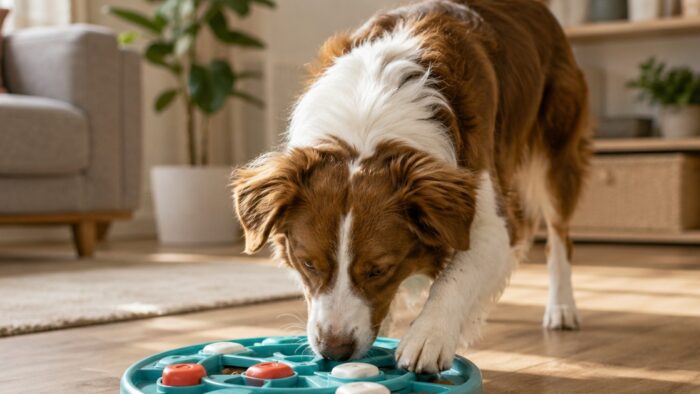
A snuffle mat is a piece of fabric with strips or pockets that food can be hidden in, turning a handful of kibble into a foraging puzzle. You can buy one or make your own from strips of fleece tied through a rubber mat. To use it, scatter food into the strips and let the dog work it out with its nose. It slows fast eaters, occupies a dog while you are busy, and provides a satisfying ten minutes of work. It sits naturally alongside the other slow-feeding ideas in our piece on puzzle feeders.
Simple scent games to start with
- Find the treats. With the dog watching, hide a few treats around the room, then release it to find them. Make it easy at first and harder as the dog gets the idea.
- The cup game. Hide a treat under one of several cups and let the dog sniff out the right one.
- Scatter feeding. Toss part of a meal across a clean floor or the garden so the dog hunts for each piece, turning dinner into an activity.
- Find a named toy. Teach the name of a toy, then hide it and ask the dog to find it, building a fun search game over time.
Keep sessions short and successful, especially at first. The aim is for the dog to enjoy using its nose, not to get frustrated by a puzzle that is too hard too soon.
Fitting it into a routine
Scent work is a flexible addition rather than a replacement for walks and play. Use it to take the edge off a high-energy dog on a busy day, to occupy a dog that has to be left for a while, or to give a recovering or older dog gentle stimulation when hard exercise is off the table. It pairs well with the indoor activity ideas in our guide to indoor enrichment for energetic dogs, giving you a varied toolkit for keeping a dog content indoors.
Let the nose lead
Scent games and snuffle mats are among the simplest, cheapest ways to enrich a dog’s day, and among the most effective at producing a calm, satisfied animal. They cost little, suit every dog, and work in the smallest home. Start with an easy game today, watch how absorbed your dog becomes, and you will have a reliable way to tire its mind whenever a walk is not enough or not possible. Trust the nose; it does more than you think.
Frequently asked questions
Can sniffing really tire a dog out?
Yes. Scent work uses a large part of a dog’s brain and is mentally demanding, so a short, focused session can leave a dog as contentedly tired as a much longer walk. It is especially useful on days when physical exercise is limited.
How do I make a snuffle mat at home?
Tie strips of fleece through the holes of a rubber sink or anti-fatigue mat until the surface is densely covered, then scatter kibble into the strips for the dog to find. It is an inexpensive project and works just as well as a shop-bought mat.
Are scent games suitable for older or recovering dogs?
They are ideal. Nose work is low-impact and can be made as gentle as needed, giving an older or recovering dog satisfying mental stimulation without strenuous movement. Keep games easy and short, and check with your vet about activity if your dog is unwell or recovering.
How often should I do scent work with my dog?
As often as suits you and your dog, from a quick daily snuffle to a few longer sessions a week. It works well as part of a varied routine alongside walks and play. Keep individual sessions short and successful so the dog stays keen.