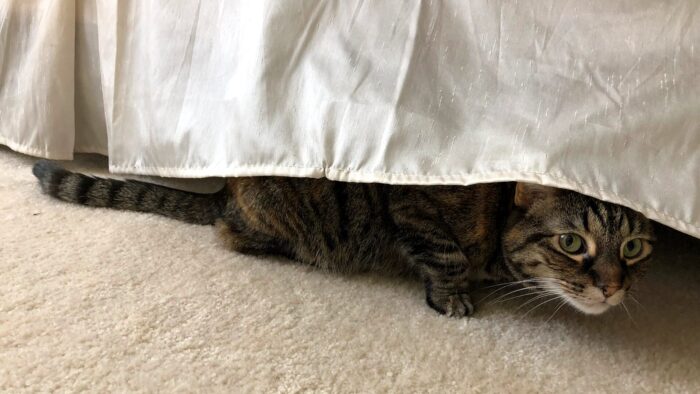
Moving a cat that has had free outdoor access to an indoor life is one of the harder behaviour changes to manage. It can be done, and plenty of cats end up happier for it, but doing it abruptly and without replacement enrichment produces weeks of yowling and a frustrated household. If you are still weighing the decision, start with the honest comparison of indoor and outdoor cat welfare.
Before you start
Have the replacements ready before the door closes for good. A cat that loses the outdoors and gains nothing will protest far longer than one whose indoor world improved on the same day.
Set up in advance:
- Vertical space: a tall cat tree, wall shelves, cleared window sills
- At least two window perches with a view, ideally onto a garden or bird feeder
- Scratching posts, both vertical and horizontal, in the rooms the cat uses
- Litter trays – one per cat plus one, in quiet, separate locations
- Puzzle feeders and a few wand toys
- A hiding place at height and one at floor level
Gradual is better than sudden
If circumstances allow, taper access over several weeks rather than stopping overnight.
- Weeks 1-2: keep the cat in overnight, which is a good habit anyway, and let it out later each morning.
- Weeks 3-4: reduce outdoor time to a supervised hour or two at a set time each day.
- Weeks 5-6: move those sessions to a harness, a catio or a secure garden if you have one.
- Week 7 onward: indoor only, with the enrichment routine fully established.
If you are moving house, a sudden change is often easier – the cat has to be confined for several weeks anyway, and there is no familiar door to demand.
Expect a protest phase
Yowling at doors, pacing, door-dashing and night activity are normal for the first two to four weeks. The hard part is consistency: a cat let out once after three days of yowling learns that persistence works, and the protest will last far longer next time.
Manage door-dashing practically. Use a two-door airlock where possible, keep a toy by the door to redirect, and feed a small meal at the times the cat used to go out so the moment becomes associated with something good.
Replace the hunt
This is the part people skip. Outdoors, a cat performs the full hunting sequence many times a day. Indoors it has to be recreated.
Run two or three short play sessions daily with a wand toy, moving it like prey – stop-start, hiding, short dashes, never dangling it in the cat face. Let the cat catch it at the end, then feed a small meal. Stalk, chase, catch, eat, groom, sleep – completing that sequence is what settles a cat rather than winding it up.
Feed from puzzle feeders and scatter dry food around the house so eating takes effort. A cat that works for food is a calmer cat.
Build the outdoors in
A catio is the single most effective addition. Even a small window box enclosure gives fresh air, sun and smells. Cat grass, a bird feeder outside the window and a tray of safe outdoor leaves or soil brought inside all help.
Watch for problems
Some protest is normal; some signs are not. Contact a vet if you see spraying or house soiling that persists, overgrooming or bald patches, loss of appetite for more than a day or two, hiding constantly, or aggression that is new. These can indicate stress that needs a different approach, and some have medical causes that need ruling out first.
Synthetic pheromone diffusers help some cats through the transition. They are not a substitute for enrichment but they take the edge off.
Timescale
Most cats settle within four to eight weeks. Older cats and those that roamed for years take longer. The ones that adapt fastest are the ones whose indoor life became visibly more interesting on the day the door closed.
The Realistic Timeline, Week by Week
Most transitions fail because owners expect acceptance in days. The honest arc runs in weeks. Weeks one and two bring door-dashing and protest meowing; your job is pure consistency, since one surrender teaches the cat that volume works. Weeks three and four, the protests shorten as new routines take hold, and this is when enrichment must ramp up: scheduled play sessions, foraging feeders and the ideas in our free enrichment list replace the stimulation the territory used to provide. By weeks six to eight most cats have transferred their patrol instincts to windows and the indoor routine. Cats with years of outdoor habit may need a few months plus a transition aid like supervised catio or harness time, which gives outdoor sensory input without outdoor risks.
Should you use a partial-access compromise?
Half-measures like letting the cat out “sometimes” are the one approach that reliably fails, because intermittent reward is the strongest motivator in animal behaviour; the begging never stops. Decide fully in, then make inside genuinely rich. Watch for the stress signals in our body language guide and escalate enrichment rather than opening the door.
Featured image: Cat on a Leash Enjoying the Outdoors. Photo: Rbreidbrown (CC BY-SA 4.0), via Wikimedia Commons.